
In many ways, communication peaked with the postal service. A letter is the perfect balance of intimacy (a physical artifact passed from hand to hand) and distance (crossing space and time via a vast, anonymous network that may as well be magic).
Yes, it seems strangely formal compared to the casual familiarity of email (itself embarrassingly antiquated next to texts and DMs), but that’s increasingly looking like a feature, not a bug. Committing your sentiments to paper respects your correspondent’s personal space. It’s a way of saying “I’m thinking of you” without also immediately implying the question “Are you thinking of me?” Letters are designed to be “left on read.”
This is ideal for the kinds of messages that are meant to be one-sided: condolences, congratulations, apologies. Expressing these in a more immediate medium can leave the exchange feeling awkwardly unfinished. (Are we the only one who’s ever gotten trapped in an escalating battle of “thank you” emails?)
But a piece of mail is also a nice way of just keeping in touch, a gift of our attention and time that “hits different,” as the kids say. Probably because opening that envelope and handling what’s inside yanks us, however briefly, from our disembodied, virtual existence. Insofar as it does us this tender favor, every letter is a love letter.
PROVISIONS
When engraver John Dempsey and businessman George Carroll opened their New York stationery company in 1878, they also published advice on etiquette. Selling people paper and then explaining all the occasions that required a handwritten note was a sound business model.
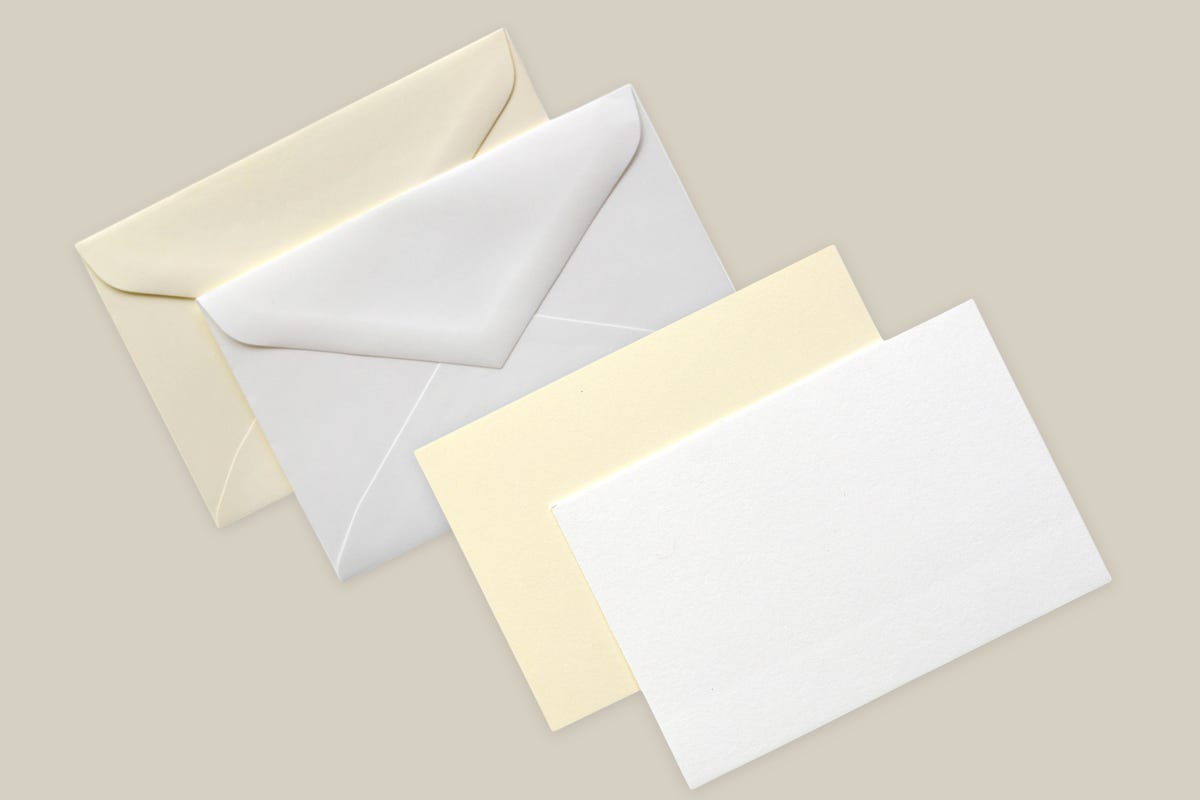
Dempsey & Carroll still gives you good reason to find an occasion. Its correspondence cards come in substantial three-ply stock, thick and pleasant to write on. You can, of course, write a perfectly good letter on printer paper. But there’s something to be said for giving your correspondent a nice piece of paper to hold onto. And a blank card saves you the trouble of finding a greeting-card writer who happens to share your sentiments.
Start with the Basic Dempsey #3 cards in ecru: $15 for ten, plus $15 for ten matching envelopes. No need to get your name engraved just yet. Keep a supply in a drawer for the next time someone deserves more than a text.
TRAINING
Reading an original poem is a perfectly pleasant and thoughtful way to commemorate any number of occasions, from weddings to retirement parties to funerals. And yet the predominance of free verse has trained many of us to associate poetry with unchecked “self-expression” and that drearily unnatural, plodding cadence that announces “I’m reading a poem.”
As is often the case, the trick to avoiding such pitfalls is to return to the rules we’ve unwisely discarded. Following a strict form makes it easier for even the most tin-eared among us to create something serviceable. It may not be Shakespeare, but your audience will certainly appreciate your effort, not to mention your restraint. Poet Rachel Richardson’s guide to writing a sonnet supplies examples and exercises to get you started.
CULTURE
In an age of YouTube pranksters, internet trolls, and instant gratification, conducting an elaborate practical joke through the U.S. Postal Service seems impossibly quaint. Write a letter, put a stamp on it, wait weeks for a reply, and perhaps write another.
That’s how comedian Don Novello, later famous as Father Guido Sarducci on Saturday Night Live, amused himself in the 1970s. Writing as Lazlo Toth, he sent letters to politicians, celebrities, and corporations, collecting the exchanges in The Lazlo Letters (1977).
Novello’s comedic weapon of choice is cheerfully deranged enthusiasm, wielded on everyone from Richard Nixon and McDonald’s founder Ray Kroc to Henry Kissinger and the makers of Mr. Bubble (why, he wonders, does the package say “KEEP DRY”?). Toth offers his correspondents unwavering support and an unnerving confidence that they’ll read every word.
When Gerald Ford solicited ideas for conserving energy and fighting inflation, Toth suggested going to bed at eight, opening the refrigerator only three times daily, and flushing every other time. The White House thanked him with a form letter and two WIN (Whip Inflation Now) buttons.
Not everyone relied on a form letter. “Most people, regardless of their sentiments, don’t take the trouble to express themselves as you did,” Nixon confidant Bebe Rebozo replied to Toth’s suggestion that the president explain away his recorded use of “Jew boy” as “Julie’s boy”—a boy his daughter liked.
Even H. R. Haldeman, recently fired as Nixon’s chief of staff, found time to answer. Toth had advised him to restore his old flat-top haircut, which reminded him of Tab Hunter. Perhaps Nixon would give him another job. Haldeman assured Toth that his longer hair wasn’t a symptom of post-firing malaise. He also apologized for the delay, explaining that “it took awhile for the letter to reach me from the White House.”
EXEMPLAR
When his North Vietnamese captors moved Air Force pilot Carlyle “Smitty” Harris out of solitary confinement and into a cell with three other American prisoners in 1965, the men stayed up all night talking. “We were ecstatic,” he recalled. Four days later, they were put back into solitary.
By then, Harris had taught them something he remembered from an escape-and-evasion instructor: a code that arranged the alphabet in a five-by-five grid. Two sets of taps identified each letter by its row and column. The men could continue their conversation through the walls.
The code spread. Prisoners exchanged news of their families, warnings about interrogations, jokes. They learned to reproduce the tapping patterns in the strokes of a broom, a series of coughs, even the chopping of weeds. Discovery could mean torture, but they kept finding ways to talk.
Some messages needed only three letters. In his memoir, Harris recalled how men returning from torture would hear, within minutes of being locked back in their cells, the taps for GBU: God bless you. The men on the other side of the wall knew what had happened. They wanted them to know they were there.
PROVISIONS imagery courtesy of Dempsey & Carroll.